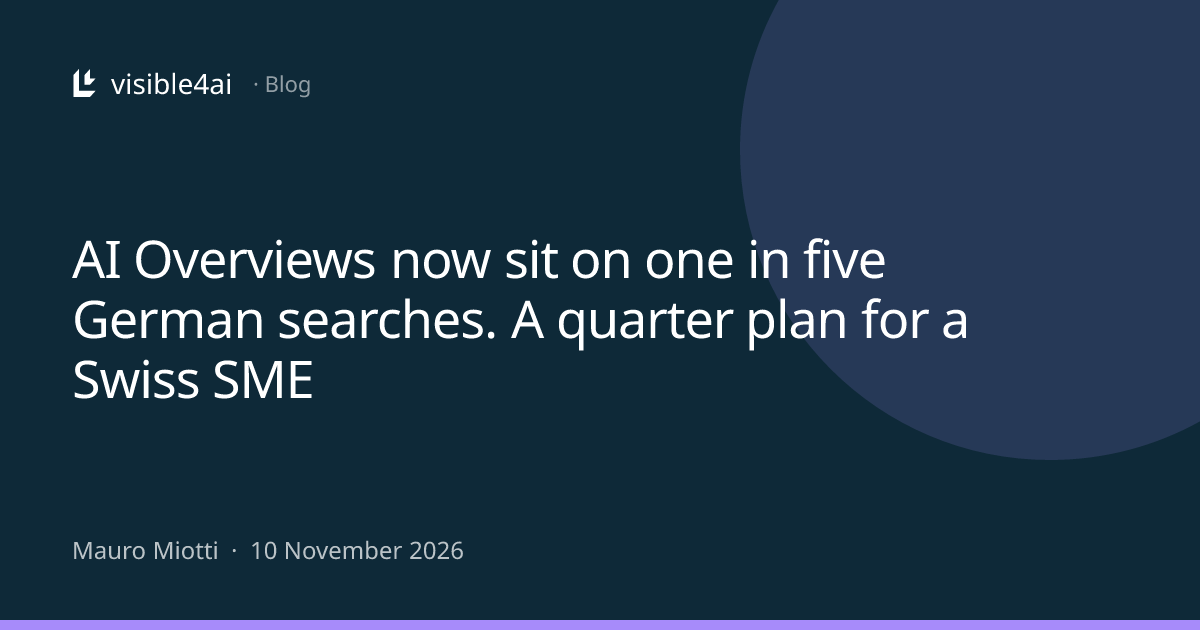
AI Overviews now sit on one in five German searches. A quarter plan for a Swiss SME
SISTRIX measured AI Overviews on just over 20 % of German keywords; Pew found clicks halve when one appears. Four numbers worth knowing, and five things a small team can do in the next ninety days.
 Mauro Miotti3 min read
Four numbers, each from a source you can check, then a plan.
The numbers
Just over 20 % of German keywords now show an AI Overview. SISTRIX measured it in February 2026 across the German index (source). Swiss German-language search runs on the same engine and the same model, so there is no reason to expect the Swiss number to be far off.
When an AI summary appears, users click a regular result about half as often. Pew Research tracked real browsing in the US in 2025: 15 % of visits ended in a click on a result when there was no summary, 8 % when there was one (source). The summary answers the question; the click was the question.
Brands are 6.5 times more likely to be mentioned in AI answers through third-party pages than through their own. AirOps analysed where the cited sources come from in October 2025 (source). The answer engines trust what others say about you more than what you say about yourself, which is the opposite of how most marketing budgets are spent.
Deliberate optimisation for generative engines can raise visibility by up to 40 %. That is the headline result of the paper that coined the term GEO, Aggarwal et al. at KDD 2024 (source): adding citations, quotations and statistics to a page measurably increased how often engines used it. Up to, in a controlled setting; but the direction has held up.
What this means for a small company
The traffic you got from being result number three is being replaced by a paragraph that either names you or does not. Your ranking did not fall; the click moved. For a Swiss SME with a five-page site and no SEO team, that is uncomfortable news with one consolation: the things that get a site named in a paragraph are mostly things a small team can do in a quarter, and most competitors have not done them.
Five things in ninety days
1. Find out whether you are named today. Before anything else, measure. Pick the five questions a customer would actually ask ("best Treuhänder in Winterthur for a small GmbH", not "Treuhand Winterthur") and see what the tools say. The free analysis on this site runs that check against four of them.
2. Put a real answer in the first paragraph of your key pages. Not a welcome, not a slogan. If the page is about your service in a city, the first paragraph says what you do, for whom, where, and what it costs or how to find out. Engines quote first paragraphs; the GEO paper's finding was essentially this plus evidence.
3. Put a person on it. A name, a role, a date, a photo if you have one, and a profile somewhere else that confirms the person exists. Answer engines, like Google's raters, weigh a named human with a track record far above an anonymous brand voice.
4. Publish the discovery files. llms.txt and ai.txt at the root of the site, then the rest. They do not force anything, but they remove reasons to misread you, and almost nobody in your market has them yet.
5. Get mentioned somewhere that is not your site. Given the 6.5×, this is the one that does the most and looks like the least: a directory your trade association runs, a regional newspaper's business pages, a partner's "who we work with", a conference programme. One good third-party page beats five of your own.
Then measure again
Run the same five questions in a month, and in three. Visibility in AI answers moves slowly and not in a straight line, and the tools change under you; the only way to know whether the quarter worked is to ask the same questions you asked at the start.
None of this guarantees a citation, a ranking or a visitor. What it does is remove the reasons an engine would pass over you, and let you see whether it stopped.